Sunday, August 30, 2015

Teach Like a Champion- The Ultimate Tool to Ramp Up Your Teaching

I am exhausted. What a great, but crazy, first week back to school! My feet are aching and I'm hoping the tickle in my throat is just from allergies....... I have a great group of kiddos and I have my work cut out for me this year! It's going to be great!

Tomorrow I am welcoming a student teacher in my classroom for the very first time. I'm a little nervous because I really don't feel like I have much to offer, but I'm hoping she will pick up some knowledge along the way. To ensure that she does, I insisted that she get the book I describe below and we use that as kind of our "textbook" for her student teaching experience. I have been meaning to share about this book for awhile, so now seems like the perfect time!

Several years ago, in the midst of one of the my toughest teaching years to date, I happened to stumble across this book:


Little did I know as I cracked open the first pages, that this book would completely transform my teaching.

People always say that "teaching is an art." Yes, yes, yes. I firmly believe that there is a definite art to teaching, there's a human and affective aspect that must be present along with having a deep understanding of content. However, what author Doug Lemov and his team have done is come up with concrete strategies they have seen highly effective, or who they call "champion teachers," use- strategies that are common between teachers across districts, cities, and states. Essentially, they have pinned down some of the "art" of teaching into directly replicable techniques. Not only does this book give a name to specific techniques, it also creates a common language among teachers so those techniques can be analyzed and discussed.

Sounds too good to be true, right? I thought so at first. But once I started reading, I literally could not put the book down. Remember, when I first found this book I was in my third year of teaching with a tough, tough, tough, group of kiddos. You can read more about that year HERE. :)

One of the first techniques that really hit home with me is called "No Opt Out." In a nutshell, this technique does not allow a student to simply "opt out" of answering a question. If you call on a student and they don't know an answer, Lemov gives you practical classroom examples of how to respond to the student, provide various types of cues, hints, or questions, but always returning to the student to have them answer the question- even if it comes down to them simply repeating what you say.

As a young teacher still feeling slightly intimidated by my class, this technique was hard to follow at first. I had boys that would get upset and and angry when I called on them. But with consistency and persistence, the class got used to knowing that they would be held responsible for answering every question. Slowly but surely the culture of my classroom began to change and I found my confidence.

Another small example he mentions in the book that has stuck with me, and I really don't even think this is its own technique or strategy, but it's the simple concept of standing still when giving directions. Man, I thought I was on fire those first few years. I could walk and talk and pass out papers and give directions, and find the pen I left on my back table, and correct little Johnny's behavior... I was a multi-tasking, let's-get-things-done machine. But inevitably, when I was through giving my directions and thought I would take a well-deserved deep breath, fifteen hands would shoot up in the air because they didn't understand a thing I said. They were too distracted by all of my movement to even think about the words I was saying.

Again, looking back now, it seems so obvious! I should have checked in to see that students were hearing me and understanding my words. But with my sense of urgency and feeling the time crunch, I thought I was making the best use of time.

The examples I gave are just a few of the many. The book is divided into chapters with overarching themes and it's meant to be read on a what-I-need-at-this-moment basis. When I first found the book, my focus was on the classroom management type techniques, as I described above. As I have evolved and grown, my focus is now more on the techniques that promote higher-level thinking. But of course, without strong classroom management, the environment isn't ripe for critical thinking anyway. I have revisited the book with a new lens each year as I get a new group of kiddos and add more tools to my toolbox. This book is a great resource for every teacher, whether you are just starting out, or a twenty-year veteran.

I realized after talking with my student teacher that there is a new and updated version of the book: Teach Like a Champion 2.0!  This version has even more techniques and expanded commentary. I am so excited to dig back in and revisit all the great things this book has to offer!


The new book is divided into four major parts with several techniques subdivided in the chapters within. Below is an outline of just the four parts and included chapters. These are not the specific techniques themselves!

I highly, highly, highly suggest looking into this book. There is always room for improvement and growth, and as a teacher, I never stop growing. In just the little bit I've looked through in the past few days, I already have some goals for myself.  It. Is. Fabulous. 

Have a great week!!


Tuesday, August 4, 2015

Reading is Like Eating a Snickers

Have you ever heard someone say something in relation to a concept you have taught many times and you just want to kick yourself because you didn't think to say it quite like that before? The way they said it makes it so clear and you just go, "Ugh! Why didn't I think of that?!"

Well, that happened to me last week while attending a reading training. The presenter shared this amazing little analogy that rocked my world. Ready for it? Here it is:

Reading is like enjoying a Snickers.  

Allow me to explain.

This particular training was about fiction texts and how to make elements of plot more understandable for students. The conversation turned to struggling readers and the presenter told us a story.

She told us about an experience she had when she was working with struggling high school readers several years ago. She realized that they were not truly thinking about what they were reading, but rather just word calling. So, one day she brought in a mini Snickers for each student. The kids were obviously excited and wanting to enjoy the candy. However, she told them that if they wanted to eat the Snickers in class, they could NOT chew it at all.  Of course the students were upset saying, "What's the point of eating a Snickers if you can't chew it up? That's the good part!"

Lightbulb!

And so she explained to the students, "If you were to just swallow the Snickers whole, you miss out on all the great flavors. The best part of eating a Snickers is when all the different flavors mix together in your mouth: the peanuts, the chocolate, the caramel, and you get all that deliciousness swirling around. The same thing happens when we read. Something is supposed to happen. The words come off the page and swirl around in our brains. They mix with all the things we know and answer questions we might have. The words help us make a picture in our minds. That's what it means when we read and think at the same time. There's a lot going on in your mouth when you eat a Snickers, and there should be a lot going on in your head when you read."

I mean, seriously! How simple! How relatable! How perfect!

Struggling readers who lack the ability to visualize and truly think when they read miss out on the joy of reading, the deliciousness. Making this concrete connection to something so simple shows kids how enjoyable reading can be.

Why didn't I ever think of that?!

Here's a little graphic that puts it as succinctly as I could:


Thank you so much to the amazing lady who shared this great analogy!! ;)


Blog Signature photo Screen shot 2015-06-16 at 8.05.02 PM_zpsj3fmrvak.png

Thursday, July 30, 2015

Pencils: A Painless Solution


My first year teaching I realized what a mega nightmare pencils can be. Seriously. Broken pencils, missing pencils, pencils became a huge issue. I cannot explain to you how much I absolutely abhor the sound of an electric pencil sharpener. It literally makes me cringe. Two years ago I found the most amazing solution from The Wise Owl Teacher. You can download her explanation of her system HERE.

Introducing... The Pencil Bag! I know, earth shattering, right? It's so simple.

Here's how it works:

Each student is given their own pencil bag similar to the one shown below.

Image: Office Depot


The first year I used this system pencil bags were not on the supply list, so I bought them myself. I used the cheap plastic ones from the Dollar Store. By the end of the year only a few were still intact. Thankfully, at my new school they are on the supply list! Score! The sturdier nylon ones with a real zipper work the best. Trust me.

 On Mondays, each student makes sure that they have at least five pencils in their pouch and I sharpen them. I know, I know, third graders are completely capable of sharpening their own pencils, but I just cannot let go of the pencil sharpener. I have been through too many to give it up! Plus, it gives me the opportunity to check in with each individual student on Monday and ask about their weekend. ;) In my classroom the students keep all of their extra supplies in Sterilite storage containers that I store on a bookshelf. They are easily accessible and the kids can restock their bags as needed on Monday mornings.

After we sharpen pencils on Monday, not ONE pencil gets sharpened the rest of the week. Each kid has five pencils to ensure that even if one breaks, they have a reserve supply. If all five pencils are broken before the end of the week, they must borrow one from a friend. We resharpen pencils and restock the bag as needed each Monday.

In two years, I have not had issues with pencils. Honestly. Last year I adapted the 'pencil bag' into the 'supply bag' to include other basic supplies that students need on a daily basis. I give them this letter on the first day of school that explains the pouch and the expectations:


The beauty of this system is that it teaches the students to be responsible and keep up with their supplies. If a student is constantly needing to restock with five brand new pencils each week, I have a conversation with them to figure out what's going on and help them come up with a plan. This year I'm upping the expectations and fining them a dollar each time they do not have their supplies when we need them during class. Because we do not start our classroom economy until we are a few weeks into the year, the students will have plenty of time to get into the routine.

The first year I gave the students some type of reward for keeping up with their supplies each and every week. I felt like this was contradictory to what I was trying to promote. The kids were keeping up with their supplies, but not because they saw it as a necessity but a way to earn a reward. This past year I phased out the rewards as the year went on. This year I am stopping the every week reward and will be performing random checks instead. If you notice in the letter above, it says they "might" earn Scholar Dollars during these checks, meaning they will not earn a physical reward each time.

This is what the letter looked like two years ago when I first used this system.


We used a communal system  at that time so I kept all of the pencils in my cabinet and refilled the bags myself and sharpened the pencils on Fridays. I like the current system much better!

Well, that's it! Simple, but effective. I never have to think about pencils or even look at the pencil sharpener ALL WEEK!!

Do you have any great ideas for pencil management?? If you do, please share!


Blog Signature photo Screen shot 2015-06-16 at 8.05.02 PM_zpsj3fmrvak.png

Wednesday, June 17, 2015

A Year of Change PLUS My Summer Reading List

This past school year was a tough one for me. I changed districts and schools and the change had more of an impact on me than I expected. In the six years I’ve been teaching I’ve moved districts three times, moved schools four times, and changed classrooms five times. Whew! It seems crazy when I write it down like that. Change is something I have grown accustomed to, but this year really shook me.

I’ve written about my “journey” as a teacher so to speak in previous posts, especially the one about Rita Pierson, the amazing educator who had a profound impact on me. The first few years of my career presented many challenges. I taught a majority of kids from poverty and who lacked even the most basic manners.

Getting my classroom to run smoothly took months. Simple routines took extensive modeling, practice, more modeling and more practice. Lots of my time and energy went into teaching kids how to speak correctly, how to behave, and how to interact. I grew tremendously by learning how to connect with my students, build and maintain meaningful relationships, and manage my classroom without the throwing of chairs and cursing.  I had found strategies that worked thanks to mentor texts like Teach Like a Champion and The Essential 55. I got a little bit better each year. By year five, my teammates and I had built a strong team, one that was held in high regard with our administration. We had great success with our students and I felt successful and competent.

And then I moved. My entire world was different. I taught a new demographic, one that was different than any other I have taught before. My students were mostly white and middle class. The students sat quietly and listened on the first day of school- the first day of school! I didn’t have to remind students not to yell in the hallway or not to push each other on the playground and I could actually turn my back for a few minutes and not worry about a fight breaking out. It was a whole new world!

What this meant, however, is that with that entire layer of behavior management no longer needed, I realized how little I knew about how to actually be a good reading teacher. Yes, I could connect with students, and yes, I could manage my classroom, but as far as actually progressing my students’ learning, pushing them beyond their current levels, I realized there was still so much I needed to learn. I tried my best and did what I could, but the entire year I felt a sense of emptiness and failure. I felt like I didn’t have enough knowledge to really produce the results and growth I knew the students were capable of. I hate to say this, but I actually fell into a bit of a funk for several months. I felt defeated and lost my motivation. Let’s call it what it is- I had wounded pride.

Well, I am happy to say that after a lot of self-reflection, I am back to my old self again! I have come to accept the fact that my past experiences have given me a solid foundation to handle a variety of behavior issues and have blessed me with the opportunity to learn to connect with students and I am very appreciative of even the worst experiences I have gone through. The next step in my journey as a teacher is to beef up my instructional strategies. So, I’m dusting off some books I bought last summer but never read and starting some new ones, too. I am confident that these books will give me the jumpstart I need to really enhance my instruction and give me the tools to progress my students’ learning.


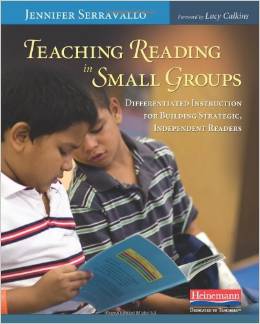
1. Teaching in Small Groups: Differentiated Instruction for Building Strategic, Independent Readers by Jennifer Serravallo


I’ve spent almost half the day reading this and I can’t put it down. I love the way she scripts out the conversations she has with her students and provides lots of great ideas to engage readers. I will be able to easily implement these mini-lessons.

2. Conferring with Readers: Supporting Each Student’s Growth and Independence by Jennifer Serravallo


I have read a portion of this one in the past, but I’m ready to really dive in and learn how to make those precious one-on-one conferences with students most effective and efficient.

3. The Reading Strategies Book: Your Everything Guide to Developing Skilled Readers by Jennifer Serravallo


Are you noticing a pattern? Serravallo is a brilliant woman! This is an absolute goldmine of a book! In this book, Serravallo shares 300- yes, 300!- explicit strategies to teach readers- from emergent to proficient. Each strategy is described by telling which levels would most benefit from it, which genres work best, and which skills are enforced. It’s full of colored charts and actual student examples. Like I said, goldmine!

4. Making Thinking Visible: How to Promote Engagement, Understanding, and Independent for All Learners by Ritchhart, Church, and Morrison


I’m about 1/3 of the way through this book and I am hooked. One of my big goals is to provide more opportunities for critical thinking and this book provides 21 strategies to do not only that, but also enhance students’ understanding of what it means to think and learn. The book also gives lots of ideas on how to make students' thinking visible so as the teacher, I can better assess their understanding. 


I have several other books on deck, but these are the four I’m going to be making my way through first. I’m sure I’ll have some more to say about each book as I get into them!


Before I go, I do want to say this. After moving districts and teaching a new demographic, I have an even deeper appreciation for my job and feel more compelled than ever to do my job to the best of my ability. Kids, no matter where they come from, all deserve to have an amazing teacher. Regardless of how different one school is from the next, I am determined not to let myself fall into a funk again. Time is too short and my job is too important! I have come to peace with the fact that I did the best job I could with what I knew at the time this past year. I will continue to grow and improve and I know that I will never be perfect. Just as I teach my kiddos, learning is never done!   I think Maya Angelou says it best!


Blog Signature photo Screen shot 2015-06-16 at 8.05.02 PM_zpsj3fmrvak.png

Tuesday, June 16, 2015

Five Reading Series...for Boys! (Hopefully!)

Boys.  I always have the hardest time finding fiction books for my reluctant boys, especially ones who are struggling readers. They love to read non-fiction and would read animal books and sports books and hurricane books all day every day. But when it comes to fiction, it seems like the books geared for boys go from super easy to too hard and there’s hardly anything in between.

Last year, several of my boys loved mysteries so they read A-Z Mysteries and other similar series like crazy. But for my other boys, I wasn’t quite so lucky. Some of them religiously carried around a copy of whatever Diary of a Wimpy Kid book they could get their hands on and pretend to read and understand it, while others would just shut down altogether after spending several minutes browsing the shelves only to find nothing they even wanted to try to read. I realized that my classroom library had lots of variety for girls, but not much for boys. 

Last week while I was browsing the shelves at the local public library, I came across five reading series that I was mostly unfamiliar with. Some I had seen before but never read and some I had never even heard of. I read a book from each series and I'm kicking myself for not knowing about these sooner. The following five series offer a little bit of everything in contexts I know some of my boys (and girls!) would have enjoyed. 

**Warning- At this point I am only speculating and have not recommended or given these books to any of my students (it's summer!). When I do, I will update this post!** :)

1. Rotten School by R.L. Stine


Of course I know about Goosebumps and Fear Street, but I have never heard about R.L. Stine's Rotten School series. I must have been living under a rock!! In this 16-book series, the main character, Bernie Bridges, takes part in lots of crazy antics. This series doesn’t have the horror themes of Goosebumps, but still has lots of disgusting descriptions that made me cringe! I mean, the first book is called The Big Blueberry Barf-Off, so just use your imagination! Here is the series description from KidReads:

Welcome to Rotten School! A place where Chef Baloney serves chicken with the feathers still on, where an armpit is a musical instrument, where the winning prize for art goes to the student with the best tattoo. But on this campus of losers, there's one winner who really stands out: Bernie Bridges. The king of schemers, Bernie can figure out a creative solution to any problem. Whether it's finding a way to steal --- er, win --- his hated enemy's new watch, or turning the tables on a bully by turning his dorm into a haunted house, Bernie always has a brilliant idea. Of course, things don't always turn out exactly as Bernie plans...but then, what would be the fun in that?

I highly enjoyed reading this book and I am looking forward to reading more of them.


2. My Weird School by Dan Gutman


I have seen these books before and even have a couple in my classroom library, but because I had never read them I was hesitant to suggest these to my boys. After reading one, Ms. Todd is Odd, in particular, I wish I would have been more familiar with these and I'm mad at myself for not reading them sooner! 

In this hilarious series, the main character is second-grader Arlo Jervis, known to his friends as A.J., who attends Ella Mentry School with his friends. A.J. thinks school is boring and pointless, but at Ella Mentry School, the school is crazy and the staff is even weirder! I know my boys would enjoy the bizzare things that happen. This series offers tons of books to keep readers engaged and each book features a new crazy grown-up. With three additional series, My Weird School Daze, My Weirder School, and My Weirdest School, readers can follow A.J. and his friends to the third grade where things just keep getting crazier!! 

The series also has a great website where kids can read about Dan Gutman and even see him describing his series! I have to admit that I am excited to read them all! I was cracking up!! These books range in level from 3.3 to 4.4.


3. The Secrets of Droon by Tony Abbott


In this 44-book fantasy series written by Tony Abbott, three kids, Eric, Neal, and Julie, discover a hidden rainbow staircase in Eric's basement. This stairway leads to the troubled city of Droon, a magical place full of adventure. They meet Princess Keeah and discover flying lizards and magical furry creatures. With the help of a wizard named Galen, and a furry red-headed spider troll named Max, they fight to help save Droon from the evil Lord Sparr. This series would be good for my boys (or girls, of course!) who enjoy magic and fantasy but need a fast-paced book with a less complicated plot structure that still provides engaging illustrations. The books range in reading level from 3.0 to 4.3.

Fantasy is not my favorite genre, but for a kids' series, I enjoyed reading the story. I read book 13, The Mask of Maliban. I must admit that I am a little curious to see what happens to Lord Sparr....


4. The Doodles of Sam Dibble by J. Press


This four-book series featuring third grader Sam Dibble is perfect for those students who aren't quite ready for the Diary of a Wimpy Kid and other similar series. The text looks hand-written and is full of doodles that add an additional layer of humor. Sam is a typical boy who loves doing boyish things like competing in burping contests and eating live worms. He also has a rival, Max, who Sam and the other students call “Wax" due to his annoying habit of tattle telling. Max's dad also happens to be dating Sam's mom, which only adds to Sam's annoyance. Grandpa Dibble is a hilarious minor character that adds a unique element of comedy. The books follow Sam through his school-day adventures and are quick reads. The books range in level from 3.6 to 4.1. 

I read book two, Double Trouble. I enjoyed the light-hearted nature of this book and the familiarity of the typical elementary school classroom including the class pet, a hamster named Fluffernutter. I didn't think I would like them, but I actually enjoyed looking at the doodles. :)


5. Vampire School by Peter Bently and Chris Harrison 


In this six-book fantasy series, Lee Price and his other young vampire friends attend St. Orlok's Elementary School where they learn and perfect their vampire skills. Their teacher, Ms. Gargoyle, teaches them everything they need to know, even how to blend in among the “fangless folk.” This series would be great for a struggling or reluctant reader who enjoys monsters, vampires, mummies, etc., but not the gore and violence that comes without traditional monster stories. I read book two, Ghoul Trip, and enjoyed it! The students worked together to solve a crime and even I couldn't predict the ending! I know some of my boys would have enjoyed these books and felt successful after completing them. The text is a larger print and has lots of supplementary illustrations to enhance the story. The books range in level from 3.2 to 3.7.


Well, there you have it! Jeff will probably kill me when he sees how much the Amazon bill is this month, but hey! A teacher’s gotta have books! I’m anxious to try these books out with my boys (and girls) next year and see how they feel about them. I’ll get back to you when I do! 

I realize that there was not a single book about sports. Surprisingly, my boys this past year weren't very interested in sports. I'm still on the lookout for great sports books for struggling readers, though, so if you have any suggestions, I'll take 'em! 


Do you have any experience with any of these series?? Thoughts? Recommendations? 

I’d love to hear!


Saturday, June 13, 2015

End of the Year Reading Beach Bash!

I am settling in to my summer routines, and I finally have some time to catch up on some things!!

At the end of the last six weeks to help us celebrate the last day of AR testing, my partner and I set up a Reading Beach Bash for our students.


The students could bring towels to lay on, wear sunglasses and flip flops, and bring a snack to enjoy. We used blue tarps for the water and used some inflatables and lawn chairs to help set the mood. We spread books all around and the reading marathon began! The kids loved it!

Even though it was a success, if I do this again I will definitely make it more structured next time. Because we wanted to the kids to have time to read and take their AR tests, we just had them read for the majority of the day.

Next time I will:
- have the students rotate through four or five different stations to add some variety. At some stations they will read with a partner and others they will read alone
- break up the reading blocks with short read alouds
-incorporate a procedural text station where students will make a snack after reading and following directions

Any tips for how to make this day even more successful and smooth??

Fun little side story... I will have a student teacher next year in the fall. She came to visit during our Beach Bash and as she was stepping over backpacks and goggles and inflatable monkeys, I kept reassuring her that our days were not always this crazy! Then she came with me to pick the kids up from lunch and our principal was dancing around the cafeteria in a chicken suit to celebrate money the students raised. She then made all the teachers do the chicken dance as we lined up our kids. Nothing like being thrown right into the crazy!! Welcome to the world of teaching!!


Friday, June 12, 2015

Using Social Skills Authentically: Introductions


Happy Summer!!

I am officially on summer break and it hasn't really sunk in yet. I still feel like I have a million things to do. Of course there really are a million things that I want and need to do for next year, but I don't have to do them right now. For the first time in my teaching career, I still have the key to my classroom and I can go whenever I want to over the summer!! Seriously!! Whenever I want!! That is such an amazing feeling. So maybe this summer I will actually finish some things...

Anyway, on to something more purposeful...

After my visit to the Ron Clark Academy, I knew that I wanted to take a more direct approach with my students in regard to social skills. I have always embedded social skills in our lessons, primarily using Kagan structures, and the kids do very well interacting with each other within our four walls. Though they do well in the classroom, I wanted them to have more authentic experiences using social skills outside of the classroom. Knowing that we only had a few weeks left in school, I wanted to create an opportunity for them to use social skills in a very authentic way. So, in our debriefing after our Ron Clark visit, my friend Ashley and I decided we would have our students introduce themselves to the fourth grade teachers and initiate a short conversation.

I was so excited explaining this idea to the kids, but I could immediately see the fear on their faces. They were terrified of the idea of having to walk up to a complete stranger, introduce themselves, and carry on a conversation. They had never had to do anything like this before. So, we took it in baby steps. Below is a little snapshot of the pacing I used. Even though I introduced a new element each day, we spent several days putting it all together.


The first lesson was how to greet someone. Before we got into the HOW of greeting, we talked about TIMING. This was a lesson we should have done at the beginning of the year! We discussed when it is ok to approach someone and when it is not ok. Meaning, when a teacher is already talking to another teacher, you cannot just walk right up to them and start talking. It's rude to interrupt. We discussed how to wait from an appropriate distance and catch the person's eyes. Of course, this is much easier said than done, but it was discussed nonetheless!

We talked about making eye contact, having a pleasant look on our faces, saying hello and using the person's name if they knew it. We practiced this with each other. It was so cute watching them walk around to greet each other. We then extended this practice to the adults outside of our classroom. The expectation was that from then on as they walked in to their specials class or walked through the lunch line, they would greet the adult there. The teachers had to of gotten tired of hearing the same "Good morning, _______," a gazillion times, but they were very supportive and complimentary.

After a day of this, we moved on to how to shake hands appropriately. I told them that when you are greeting someone you have not met before, you must also introduce yourself after greeting them.  I spent time explaining that a handshake is important and can either give off a sense of self-confidence or insecurity. I went around to each student and modeled how to shake hands with an appropriate grip. Once the students had an idea of what it looked like and felt like (and of course what it did NOT look and feel like), we added this step to our greetings. I had the students go around the room and greet each other and introduce themselves. We added the line, "Hello, my name is _______." Of course the kids felt silly doing this with each other when they already knew each other's names, but we had to practice!

The next step was how to initiate a conversation. I wanted my students to get a sense of who the teachers were so I wanted them to ask a couple of questions. Before asking the questions, they had to ask, "May I ask you a few questions?" and wait for the person to respond with a yes or no. To be sure it didn't feel like an interrogation, we discussed how to ask open-ended questions and how to answer your own questions and add comments so the conversation goes back and forth. For example, if a kid asked a teacher if they had any pets, they would then discuss their own pets so the conversation involved both people. I required the kids to ask only two questions out of respect for the fourth grade teachers' time. The kids practiced this with each other for several days. As they were practicing, we had several mini discussions about how to stand, where to put your hands, how to maintain eye contact, and how to show that you are actually listening to the other person. I wish I would have taken pictures. They were so stinkin' cute asking each other questions!! My wiggly students were trying so very hard to keep their hands and feet still. Sweet babies. They were determined to get it right!

The last step was how to end the conversation. We practiced using the sentences: "Thank you for your time. It was very nice meeting you! Have a good day!"

In the end, we had a script that looked like this:


After a week of practicing with each other, we were ready to introduce ourselves to the teachers! Thanks to some amazing and very flexible fourth grade teachers, my kiddos had the opportunity to meet several new people who could also possibly be their teachers next year! The kids were so nervous before going in, but they all came out smiling and excited and gushing about the teachers.

Originally, I was going to have the teachers fill out a little rubric for each student, but in the end I abandoned it because it would have taken way too much time. We did use this rubric as we practiced in the classroom, though, to be sure the students were on track.


To get an editable copy of the files shown above, click HERE

Was the whole experience very contrived? Yes. Was it corny? Yes. Did they follow all the steps when they actually introduced themselves? Of course not! But hey, we had to start somewhere! My kids who were more comfortable were able to be more genuine and natural, but for the kids who were doing well just to stand still, they needed this structure to fall back on. Many of my students had never been put in a type of situation like this before, so they were scared. Having the predictable structure eased the nervousness.

Overall, it was a success!! I'm looking forward to making this an end-of-year tradition. Next year I am going to look for ways to embed little experiences like this all throughout the year so my students are constantly using social skills in authentic ways. :)

Happy Summer!!
 

Follow on Bloglovin
Third Grade Blogger