Showing posts with label reading strategies. Show all posts

Monday, July 7, 2014

Reading in the Wild- Aha's Abound!

I went to a PD session last week and the presenter asked us to come with our "Aha's" and "Amens" about the book we would be discussing. I loved that phrasing! When I read "professional" books, that pretty much sums up my reactions- I either have an Aha! moment of new learning or a realization or I'm affirmed in what I already thought and want to say a big Amen!

So when my new teammate and friend, Lillian, surprised me with my very own copy of Donalyn Miller's new book, Reading in the Wild, I was ecstatic! Not only because she thought of me and I had my very own copy of the book and someone to share my reading obsession with, but I also had a new book to read and document my Aha's and Amens!


So this past week while vacationing in South Padre, this was my view as I read through the book. Nothing like reading in the semi-actual wild!


I read and absolutely loved Donalyn's first book, The Book Whisperer (you can read about that here) so I knew I would love this one as well. I love her ability to be frank and honest about what hasn't worked in her literacy instruction as well as offer practical solutions and strategies to try. The fact that she's from Texas doesn't hurt either! Today I want to share just a few of the major Aha! moments I had during my reading.

Before I get into those, I want to share with you the definition Donalyn has for being a "wild reader." In her words, wild readers are "readers who incorporate reading into their personal lives along with everything else that interests them." My goal is to develop myself and my students into wild readers.

Research shows that children who read the most will outperform those who don't read much. Wild readers don't read because someone told them to or to answer questions on a quiz, they read because they truly enjoy it and benefit from the experience reading offers. If that is the goal, how do I get there? Donalyn and her colleague, Susan Kelly, polled adult wild readers to gain insight into their reading behaviors. Those findings provided the structure of the book. Now, with their help, we can identify those behaviors and help design our instruction to foster the development of these habits.

In my Aha's, I'm only sharing the things that spoke the most to me as a fellow reading teacher. Although the book is overflowing with great quotes, fabulous ideas, and useful tools, my Aha's are just that- mine. They may seem trivial or obvious, but they resinated with me long after my eyes left the page. My hope is that maybe some of my Aha's will resinate with you, too.


This one hit me right in the gut. I love to read. I have read lots of books over the last few years. I read stacks of books over the summer. I call myself a reader. But can I call myself a wild reader?  What happens when school starts? The same chapter book will sit on my nightstand unfinished for several days... weeks... ok, ok, months! My primary goal is to instill a love of reading that will last a lifetime, not just for the short amount of time my students are in my classroom. Along with that comes teaching and developing the habits of wild reading. If I am not a true wild reader and "cannot" find the time or energy to read during the school year, is it fair to expect that from my students? Of course not! I am the reading mentor. I have to start walking the walk.

In the book Donalyn cites study after study that prove the positive effects of having a teacher who reads. I know the feeling that I get when I read steadily- my imagination is piqued, my vocabulary is expanded, my knowledge base grows, I feel less-stressed. Why would I give this up during the year? Yes, I'm tired, have long days, the list of excuses goes on. But as Donalyn stresses in the book: wild readers make time to read. If I'm going to serve as the lead reader for my students, reading must become a priority. I have to make time to read. No more excuses.


Connecting right back to what I mentioned in my first Aha!, if I am the lead wild reader, I must also model and teach behaviors that support being a wild reader. I love that Donalyn calls the time in between the main events in our life "edge time." She heads this section of the book "Reading on the Edge." What a great way to think about it! And how true! I hate when I find myself sitting somewhere with nothing to do- getting my oil changed, waiting at the doctor's office- all of those precious moments that could be spent lost in a great book just simply wasted. I'm fairly good about remembering to bring a book along with me when I know I'll be sitting somewhere for a long period of time, but I need to be better about keeping books with me in the car and even in my purse. I never know when those unexpected delays will pop up.

The biggest moment of clarity came when Donalyn discusses how wild reading consists of behaviors and habits that require teaching and discussion. Kids can be taught how to take advantage of this "edge time" in their own lives. I had a student last year who had mastered the art of reading on the edge. I practically had to pull her nose out of a book so she would avoid walking in to a wall! But most of my students did not have this skill and it never crossed my mind to bring it up.

Donalyn shares a story about a student stating that he just didn't have enough time to read because of his sports practices and other responsibilities. When Donalyn asked if he could read for a few minutes in the car and then read a few minutes before bed his reply was, "You would let me do that? Reading a little bit here and there counts?" Reading that pained me. How many of my students felt that way about the reading time- all or nothing? I never imagined that they would think of reading as a time distinctly set away from the rest of their day. If I thought that reading time only counted when I was alone in the house and in my favorite recliner, I would never be able to fulfill a twenty minute a night requirement! I never discussed with my students that wild readers read at all different times during the day, in all kinds of places, for different amounts of time. Reading on the edge will become one of the many topics for discussion within the first few weeks of school from now on!

So...ask me how many Goosebumps books I've read... go ahead... I'm sure those of you who know me well will already know the answer... NONE! Pitiful. I have a bin overflowing with Goosebumps books, kids who read the entire series and beg for more year after year, and yet I couldn't tell you a single thing about them. Why don't I read them? I'm a scaredy-cat! Plain and simple. I go out of my way to avoid anything remotely sinister and that just so happens to include the bin of R.L. Stine's beloved books. This is a shortcoming I have shared with my students in the past. Reflecting back on that now, I want to shake myself. What kind of example was I setting for my students? The same students who I pass book after book to with the (what I thought of as) encouraging message to "Just try it! You never know, you may end up liking it!" are watching me purposefully discard a reading experience that could be quite exciting. 

I have my go-to genres and my not-so-favorite ones.  But if I have the mindset that I want to be a true reading mentor, a lead reader for my students, I simply cannot be that mentor if the only knowledge I have of the books they may potentially read comes from the front cover and blurb. As Donalyn says, "We must push ourselves to read widely in order to best serve our students- as role models who read for diverse purposes and reading advisors who know a lot about books that appeal to all types of readers." If this was a test, I would have failed miserably. 

I'm setting a personal goal for myself this summer. I'm going to read books from the genres I typically avoid- graphic novels, fantasy, and yes, even horror. I may be sleeping with the light on some nights or pep-talking myself to finish some of the books, but I will at least be able to engage in authentic conversations with my students who love them. I want my students to see me as a true member of their reading community instead of an outsider who offers inauthentic recommendations. 


I love talking about books with others. I love the conversations that ensue. I love hearing what another person took away from a book especially when they bring up a point I hadn't considered. There's a certain joy that comes with sharing the reading experience with someone else that fuels my desire to read even more so I can discuss even more! I read books based on recommendations from others and love seeing what my friends are reading. There's nothing quite like sipping on a hot cup of coffee and chatting about a book with a dear friend. That social factor of reading is a huge one for me. If I didn't have a circle of people around me to share and enjoy books with, reading would not be the same. 

So what am I doing in my classroom to set students up to experience this same joy of sharing books with others? Besides the standard book club meetings and book talk sessions, how am I exposing students to the rich benefits of being a member of a reading society? Donalyn states, "We are all social beings who seek affiliation with others who share common values and interests. Readers need other readers." I want to be around people who enjoy reading. I want my students to be surrounded by other readers so they are immersed in a culture of reading and are inspired to continue reading regardless of where they are on their "journey to become a wild reader."

Wild readers do not only read books for a book club nor do they write a review of every book that they read. I do not want my students to see reading as a chore or as an activity necessary to satisfy another requirement like a book report or quiz. So how do I promote wide reading? Donalyn discusses ways to use "epicenter readers," those students who are experts in a particular genre or author, as mentors for other students. She provides ideas like decorating a reading door, setting up a wall for "reading graffiti," and reading community-building read-alouds to help foster a community of readers. I'm going to critically examine how I structure my classroom and incorporate a variety of ways for students to share books with each other and help create a comfortable reading home for all types of readers.


This is the culminating idea. What do I do in my classroom day in and day out that fosters my students' growth as wild readers? Do my current practices align with what wild readers do? If not, what needs to be changed or removed? Do my instructional practices help develop the habits that transform my students into wild readers? This is going to require some critical thinking, but it must be done.

 I'm going to reexamine every aspect of my classroom from entry procedures, lesson design and each moment of edge time in between. I'm not going to do this part alone, however. Another great perk of being a teacher is that I'm surrounded my amazing people who have wonderful ideas and who push me to reflect and improve. I can't wait to sit around and chat (with a hot cup of coffee, of course!) with my colleagues about how I can improve my instruction to support the goal of developing every student into a wild reader.


So now I forge ahead- rethinking my instruction with wild readers in mind while I work on developing those wild reading habits myself. As I type the Goosebumps books beckon....

If you have any ideas for how to cultivate wild readers or any other comments about Donalyn's book, I would love to hear!

Tuesday, February 18, 2014

Step In, Step Out: A Tool for Deep Thinking

One my absolute favorite parts of teaching is the collaboration and sharing. I have improved my teaching so much over the last couple of years thanks to the amazing educators who selflessly share their ideas with the rest of us. Last weekend I discovered Micheal, author of The Thinker Builder. He has lots of great ideas and resources, but I want to share one particular idea with you that has been working wonders in my classroom: Step In, Step Out.

With the new demands of the STAAR (for fellow Texans) and the Common Core for most of you, students are challenged to think about texts in a completely new way. They not only have to comprehend a text on a literal level, they must be able to make inferences, draw conclusions, use text features, etc. Beyond that, they are expected to analyze the text from the perspective of an author. Seeing a text in this way requires a much deeper level of thinking and can be confusing and difficult for students.

Enter: Step In, Step Out


The idea Michael came up with is purely brilliant. The simple terminology of "step in" and "step out" gives the students a way to anchor their thinking. It has also made my explanation of the kinds of thinking I expect much clearer.

Let's take a closer look at this strategy:

The first part of the strategy is the Step In. When we first pick up a text, it's time to Step In. Let's see what the text is all about. If we are reading fiction, we are looking at the character choices and actions and how they drive the story. We're looking at relationships and plot elements. Basically, what's happening? Michael has come up with a nice set of questions that challenge the students' thinking when they are "in" the story. The visual of the door has driven home to idea that we should be immersed in the story, seeing the choices the characters are making and the effects of those choices on others.

After we have read the text, had great conversations, and students understand the major ideas, it's time to Step Out. Now we step back and analyze the text from the mind of the author. The questions Michael poses are great for critical thinking. I especially love the question that asks about what the author is trying to do at certain parts of the story.The students have to seriously think about the choices the author made and how those choices added to the overall effectiveness of the text, or sometimes lack thereof. These questions tap into that deeper level of thinking and can leave even your highest achievers silent in thought for a few seconds (gotta love that!)  The kids love the opportunity to "judge" the choices of others, and this is a great way to apply that skill!

We used this strategy last week with poetry. We read a poem called "Oak Tree" in which the tree was speaking to a child and reflecting on how the child had grown. When we "stepped in," we took notice of the speaker (who happened to be the tree) and what he was doing. Why was he talking to a child? What is he implying with his comments to the child? How do we even know he's talking to a child? The conversation was great.

During our 'step out' conversation, we came to the question of author's purpose. I explained to the students that the poet made a deliberate choice when she sat down to write the poem. She could have easily written the poem from her perspective. That probably would have been eaiser. However, this poet chose to take on the persona of the tree. Why in the world would a poet do that? One of my students who normally offers up very surface level comments, suggested that the poet probably had a special tree when she was growing up that meant a lot to her and she wanted to write about it in a more creative way than just describing it. Yes! Beautiful! I could have cried.

We also discussed the author's choice of poetic devices. We noticed which devices were used and which were not and how those devices contributed to the feeling and mood of the poem.

Thanks to the "Step In, Step Out" strategy, our conversation was revved up to a whole new level.

This week we are reading expository texts. The strategy applies wonderfully! Today we "stepped in" to an article about the Great Chicago Fire, so kids were leaving tracks all over the place sharing the new things they were learning. They asked questions, shared some of their background knowledge, made connections, clarified the meaning of unfamiliar words, identified cause and effect relationships, etc. We were definitely "in" the text!

Tomorrow, we are going to "step out" of the text. Some of the questions I'm going to ask include:
-Why did the author choose to write this text?
-What text features did the author choose to include?
-Why did they include these features? How do they help us as readers?
-Are there any other text features the author could have included? Why? How would they help?
-How did the author structure the text? Is it story-like, or are facts just presented in no particular order? Why? How does the structure affect your interest level in the article?
-Are particular paragraphs or sections more important than others?
-How would the article be different if certain parts were left out?

You get the idea!

 I'm so excited, i can hardly wait to hear what they will offer up!

The simple terminology of "stepping in" and "stepping out" of the text has given my students a springboard for deep conversations and propelled our thinking. It can be used on any text, which makes it very versatile. I am so grateful to Michael for sharing this fabulous strategy (for FREE, y'all!). Hop on over to his blog and read his post about the strategy. He's able to explain it much better than I am and you will love his writing style. He also includes some differentiated reading response sheets to use with this strategy and a genius pop up card to help you remember those wonderful questions!

While you're there, check out the rest of his awesome resources. You won't be disappointed!

Thanks, Michael, for sharing your ideas so selflessly! You have truly made a difference in our classroom!

Saturday, February 8, 2014

Using Short Excerpts for Close Reading and Leaving "Tracks" = Pure Magic!

I'm back! I'm alive! Life has been crazy, but I finally have time to sit and share with you something that I am so excited about!!

In the past several weeks, I've had a revelation in my reading instruction. I'm kicking myself that I didn't do this kind of thing earlier in the year because it is working wonders for my students. This might take me a while to fully explain, so if you're interested, strap yourself in!

Before I get ahead of myself, let me give you some back story first...

I have taught third grade reading for several years now. I LOVE teaching reading- mainly because I love to read and get kids hooked on great literature. I love the discussion and conversation that my students and I have when we are reading together. When we are discussing a text as a class, sparks fly, thoughtful responses are offered up, miraculous insights are passed between students- sometimes it's almost magical. I could almost cry thinking about the amazing experiences I have had with my students when we are analyzing a text together.

It's on this high that I send my students back to their seats with their own story to read with hopes that the same energy will continue during their independent reading. It never failed- the energy would fizzle. The kids would read the story, answer any questions I had for them, and then quickly return to their own independent reading book. Where was the excitement?! Where was the thinking? What I wanted was for the kids to get the same experience reading by themselves as they did with me.

I started experimenting with leaving symbols during reading. We had revisited a lesson from the Comprehension Toolkit and I reemphasized how reading is thinking. Just like animals leave tracks when they walk in the snow, we can leave tracks of our thinking as we read. As a class, we came up with some symbols to use when we read.


The kids came up with their own symbols they wanted to use for different thoughts. Each student made their own bookmark showing the symbols they would use and what they would mean. Then they took this idea and used sticky notes as they read to record their thinking.


The sticky note thing was working well, but it still didn't feel right. The kids were showing their thinking, but it just wasn't quite what I wanted. Then I remembered something!

A week before the Christmas break, we had a data meeting with a consultant. She threw out an idea that really stuck with me. At the time we were discussing the major problem that I'm sure every team in the world faces each year- how to teach the students who are reading significantly below level. She said in so many words- if the kids are supposed to be reading on a level M or N, let's pull a page straight out of a novel on that level and have them read that. The idea was meant to give the kids exposure to on-level text in a less overwhelming way. The idea intrigued me so much that I tried it at home over the break. I chose a random book from my shelf, flipped until I found what looked to be an interesting page, copied it, and read it. My brain was on fire!

Here's what happened: Because I had sneaked a glimpse of the title, I was already making some predictions before I even read the words. As I read, I had no idea what the plot was or who the characters were. The first time I read it, it made no sense to me. The second time I read it, my brain was revved up. I started piecing things together and inferring like crazy. After the third time I read, I had constructed what I thought to be a basic description of the characters and the plot. It was amazing! Remember, I literally copied ONE page from a novel- ONE!

I was so excited that I took the paper down to my husband and made him my guinea pig. This time, I didn't give him any clues about the title, I just handed him the paper and asked him to read it and tell me what he thought the book was about. He did the same kind of inferring and predicting and as a reading teacher, my heart was jumping up and down! I knew I wanted to try it with my kids.

When I got back to school, I went straight to the science fiction section of my classroom library and searched through a book that I thought would be interesting. I found a page where the characters were in the middle of a war and had somehow become trapped in a net in the trees. I re-typed the page and used it with my students. I talked with the students about using the same symbols we had used on our sticky notes on this one page.

One of the characters was holding a dagger to the throat of an elderly man. Immediately questions started flying- Why would someone be threatening an elderly man? How did they get there? What was this "war" about? What is a dagger? The conversations were priceless. The kids had to use context clues and text evidence in a way that they had never done before. They only had this one page of text to guide their thinking. Anything they said had to be tied to what was in front of them. Even for my struggling readers, the amount of text was not overwhelming, so they were excited and jumping into the discussion. Together, they had come up with an idea of the plot- just from reading one page! We had made inferences about each character based on their actions and words, inferred the meaning of unknown words, and made predictions about what had occurred before this page and what would happen after. At the end of our discussion the kids were literally begging to know which book that page came out of because they wanted to know what would happen next. Could it get any better than that?!

Not only was the discussion rich, but because the students had generated symbols to document their thinking, when we were finished, the tracks left behind on their paper showed evidence of all the great things we had discussed. It truly was one of the most amazing days I have had as a reading teacher. The rest of the week I found similar excerpts from books and we did the same thing with a new text each day.

By the end of the week, the students were so accustomed to leaving their tracks that when they read by themselves, the level of excitement was finally there! They spent time really analyzing the text and showing me their thoughts by using their symbols. I wouldn't let them share anything orally until they had left some kid of track on their paper to document that thought. Each student developed their own system of symbols and I was seeing the kids in a whole new way.  I was able to gain more insight into what the kids were thinking without them having to say a single word. I felt like I had finally found the answer to keeping up the engagement during independent reading!

The next week, I took this method into a story we have read every year from our Reading Street series called A Symphony of Whales. Rather than reading the story from the book like we normally do, I decided to take only key excerpts from the story to read each day.  I retyped the sections of the story I wanted the kids to read. No illustrations, no title, just the plain text.

The first day, we read the first two pages of the story. I didn't tell the kids anything to front load their thinking or stimulate their background knowledge. I literally said, "Today we will read a new story. I want you to read it to yourself and show your tracks as you read." And off they went.

As the students read, their pencils went flying. Because we had practiced using symbols to show our thinking so much in the previous weeks, they had the tools to show their thoughts. After the students read independently, they shared their tracks with a partner.

Because they had such a limited amount of information, the students had to make predictions about what the story would be about and make inferences about the character and plot. We learned that the character lives in a very cold place and their culture is very different than ours. The kids had to visualize using only the text evidence because there were no pictures. We learned that she possessed a special gift that no one else in the village had- the ability to hear whales. That's where we stopped the first day. We discussed that every story must have some sort of problem, so we made predictions about what the problem could be. The kids inferred that it might have something to do with the whales because she had this unique gift.

The next day, we read the next excerpt. Somehow the main character, Glashka, had come upon hundreds of whales trapped in a bay that was surrounded by ice. Because I had purposely left out the part that explained how she found them, the kids again had to infer. They also adjusted their predictions about the plot from the previous day now that we had this additional information about the whales. The kids explained to me that because of her gift, Glashka was able to hear the whales calling for help. She probably would take action to help them because she obviously cared about the whales. No guidance from me, no prompting. The entire discussion came from them. Because they didn't have the next part of the story, they automatically made predictions. It was beautiful!

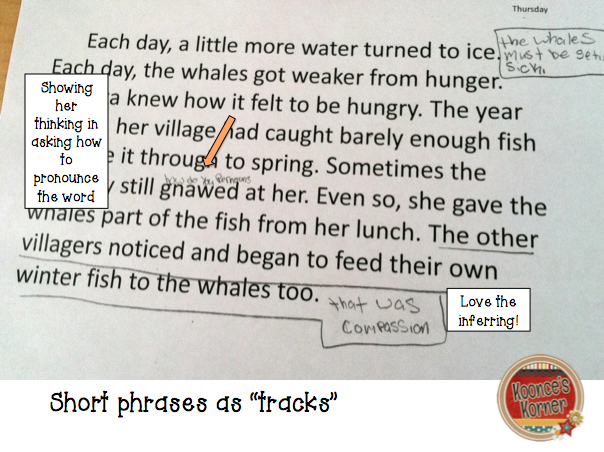
The following day we read the next section. This day I finally remembered to take pictures of what some of the kids were marking on their papers.


As you can see from the pictures, the text is plain. This is important because the kids have nothing to guide their thinking but the words. You can also see the type of thinking being shown. The kids are using symbols to show their surprise or confusion, but also leaving phrases to show evidence of inference or connections. Without writing long sentences or responses, I get a glimpse into their true understanding of the text. 

What you can't see from these pictures is evidence of the rich discussion that came after the reading. Because there is only a small amount of text, the kids have to use their tracks as a springboard for discussion. On this particular day, we gained even more insight to the problem in the story. The whales are trapped and getting weaker by the day. We also see a key trait of the main character displayed as she uses her own limited food supply to feed the whales. Seeing that the kids labeled this without any prompting from me shows that they are truly thinking as they read. 

On the back of the papers, the students had the choice to write additional thoughts, responses, or predictions. I don't have pictures of those, but you can trust that what the students' responses were more rich and authentic than anything I could have prompted them to write with my own questions. They were already putting pieces of the story together and predicting how the story would end. Most of them already noticed what I would have questioned them about! 

The last day of the week, we read the last excerpt I had chosen. It showed that the whales had been saved and set free. I purposely left out the part that described just how that came to be. The kids went wild with predictions. 

I then revealed to the kids that this story actually came out of our basal reader. The kids  jumped up and begged to read it. Yes- begged!!  I had left out many major pieces of the story, so the kids couldn't wait to read it all the way through to see if their predictions were correct. They almost couldn't contain their excitement as they searched feverishly through the table of contents to find the story. When they finally found it and saw the illustrations, many "I knew it's!" and "OOhhhs" and "So this is what it looks like's" and "I was right's!" filled the air. It was a truly magical moment. Never before had I had students so eager to read a story. Never before had they had such an appreciation of the illustrations and how they added to our understanding of the story. The room was silent as the kids soaked up every word of the story and analyzed every illustration. 

This week we followed the same format with another story from our basal. I wish I would have taken pictures of the kids' tracks this week because they were even more refined than the week we read about the whales. It just gets better and better!  

This simple strategy has majorly shifted my instruction. When I use excerpts like this, the students are truly guiding their own thinking. Even when they read a text silently to themselves, I can see thinking that I used to only hear in our group discussions. Hopefully I can remember my camera on Monday so I can show you more of what I'm talking about. :)

I urge you to try this strategy with your students just to see! I never imagined that I would be getting these kinds of results, but it is truly the best thing that has ever happened to my reading instruction!

Happy Saturday! 


Follow on Bloglovin
Third Grade Blogger